THOMSON REUTERS CORP /CAN/ (TRI)·Q4 2025 Earnings Summary
Thomson Reuters Beats Q4 Despite 7% Stock Plunge on AI Competition Fears
February 05, 2026 · by Fintool AI Agent
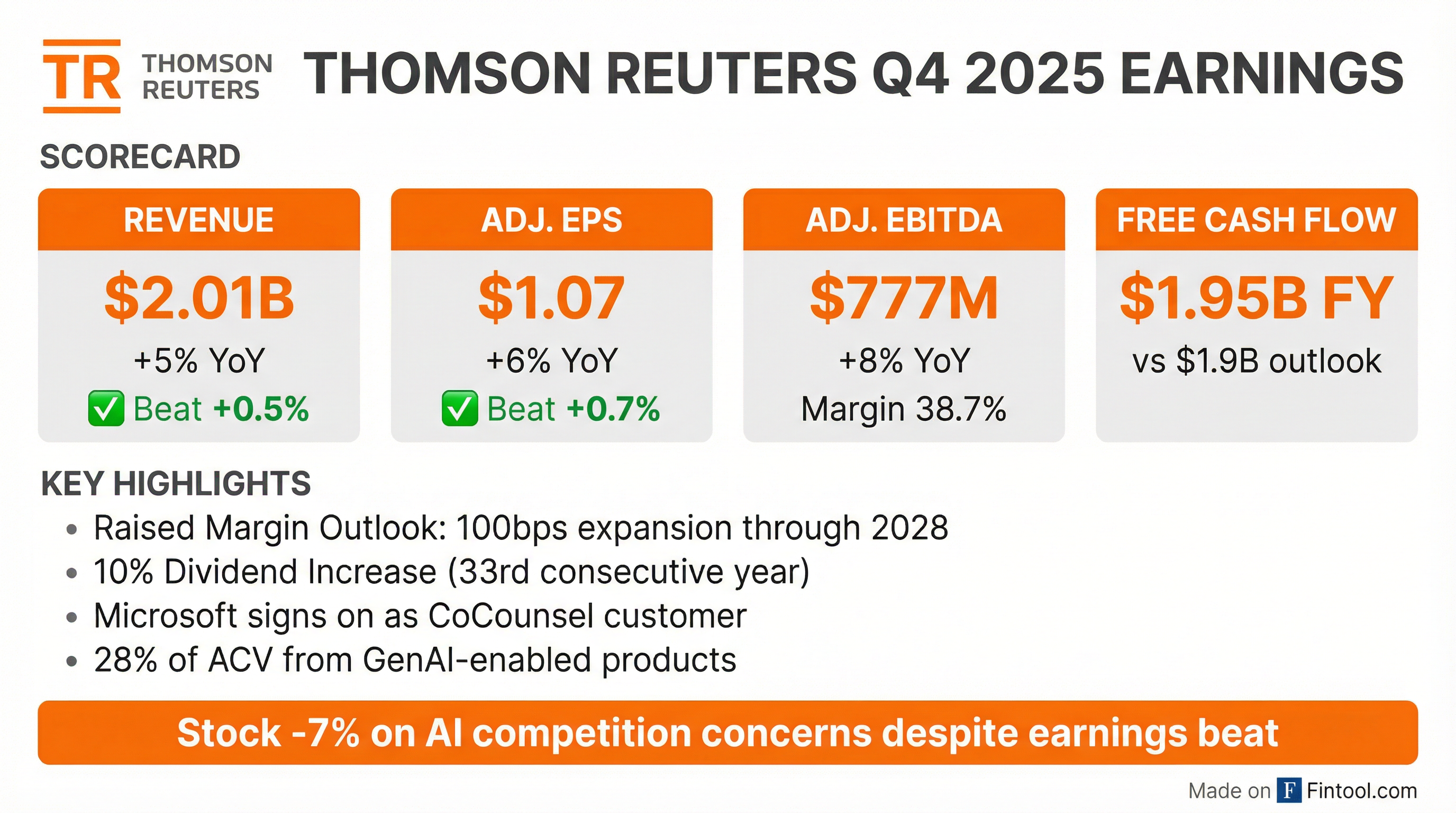
Thomson Reuters delivered a solid Q4 beat with revenue up 5% and adjusted EPS ahead of consensus, but the stock fell 7% as management spent significant time addressing investor concerns about AI competition . CEO Steve Hasker opened the call with an unusual move: directly confronting the "AI competition concerns that have led to recent share price volatility," declaring the company has "growing confidence in the value of our content and our expertise for delivering professional-grade AI solutions" .
The numbers were good. The Big Three segments grew 9% organically, the company raised its dividend 10% for the 33rd consecutive year, and management extended their 100bps annual margin expansion commitment through 2028 . But Wall Street is clearly worried about whether Westlaw's moat holds in a world of increasingly powerful general-purpose AI models.
Did Thomson Reuters Beat Earnings?
Yes, across the board:
Values retrieved from S&P Global
Full-year results also met or exceeded all guidance metrics, with organic revenue growth of 7%, EBITDA margin expansion of 100bps to 39.2%, and free cash flow of $1.95B slightly ahead of the ~$1.9B outlook .
 Ask Fintool AI Agent
What Did Management Say About AI Competition?
This was the elephant in the room. Hasker devoted the first several minutes of his prepared remarks to defending the company's AI moat, arguing that "professional-grade results cannot be delivered without this content and expertise" .
The core thesis: Thomson Reuters has two assets that matter in the AI era:
- Decades/centuries of proprietary content — Case law, precedents, and know-how curated by "highly skilled, highly trained, qualified lawyers" over generations
- Deep domain expertise — Thousands of attorney editors who now train AI agents in addition to producing content
"We have not seen a change in competitive dynamics in our areas of core franchise... We have not seen new entrants into the legal research space of any measure or importance." — CEO Steve Hasker
Management pointed to Westlaw Advantage's successful launch as validation. The agentic deep research product has "reset the bar in the legal research space" and early customer feedback indicates they've "created a new standard in legal research capabilities" .
The company also highlighted Microsoft as a new CoCounsel customer — "an important validation of our strategy and the market shift toward trusted, domain-specific AI" .
How Did the Segments Perform?
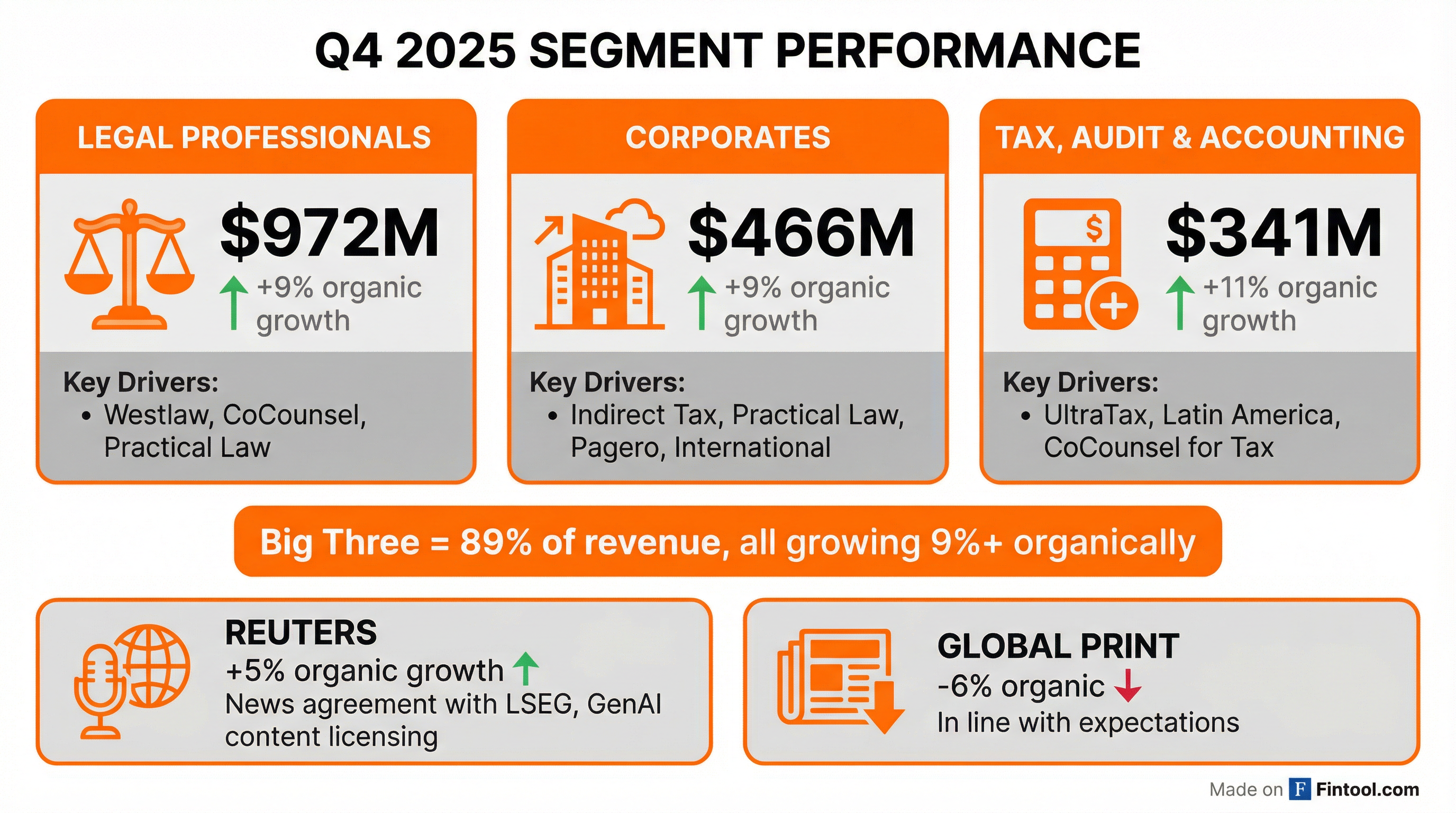
The Big Three segments delivered 9% organic revenue growth collectively :
Government business within Legal grew just 5% in Q4 and is expected to slow further in Q1 due to cancellations disclosed last quarter . However, management emphasized "legal professionals excluding government, we have clear momentum" .
GenAI-enabled products now represent 28% of annualized contract value (ACV), up from 24% last quarter and 15% when first disclosed in November 2024 .
What Did Management Guide?
Thomson Reuters reiterated its 2026 outlook and made a notable extension of its margin commitment :
Key change: Management now commits to 100bps annual EBITDA margin expansion in 2026, 2027, AND 2028 — previously only 2026 was guided . This confidence comes from internal AI automation initiatives:
- Over 300 AI use cases in development across all areas
- 85%+ of employees actively using AI tools
- Call handle time reduced 15%, first call resolution up 10%
- US content delivery to Westlaw accelerated by 25%
Q1 2026 guidance: ~7% organic revenue growth, ~42% adjusted EBITDA margin .
Ask Fintool AI AgentHow Did the Stock React?
Poorly — despite the earnings beat. TRI fell approximately 7% on earnings day, trading as low as $88.84 from an open of $97.00.*
The stock had already been under pressure in recent weeks due to broader AI competition concerns following DeepSeek's emergence and questions about the durability of content moats in professional services. Year-to-date, TRI is down significantly from its 52-week high of $218.42.*
Management addressed this directly on the call and indicated they view the current share price as attractive for buybacks. CFO Mike Eastwood noted they would need "about $500 million of share repurchases" to hit their 75% free cash flow return commitment in 2026 and that "share repurchases are definitely attractive at the current levels" .
*Values retrieved from S&P Global
What Changed From Last Quarter?
Notable Q4 actions:
- $19M in severance expense related to AI-driven automation
- Additional $10M expected in Q1, ~$20M for full year 2026
- 10% dividend increase to $2.62/share annually (33rd consecutive year)
Capital Allocation Update
Thomson Reuters maintains significant financial flexibility:
Management continues to see M&A as a priority, noting that private market valuations have remained high but that "should the events, particularly this week... in terms of downgrading the valuations of software and AI-related businesses... I think we should be able to take advantage of that" .
Key Q&A Highlights
On the moat (Jason Haas, Wells Fargo): Hasker detailed how Westlaw's proprietary content includes dissenting opinions and fact bases not publicly available, plus decades of attorney-editor interpretation that determines which precedents are relevant. "That's where a lot of the real IP is added" .
On CoCounsel commoditization risk (Toni Kaplan, Morgan Stanley): Hasker argued that fiduciary responsibility, data privacy requirements, and accountability standards mean legal AI must be "correct" — and the best way to ensure correctness is training on "a highly curated, trusted, accurate data source. We have that, and very few, if any, of the new entrants have access to such a data source" .
On pricing (Anna Wu, Goldman Sachs): The company does NOT price on headcount/seat licenses, meaning AI-driven efficiency gains at law firms benefit rather than hurt Thomson Reuters. Slightly higher pricing yield expected in 2026 vs 2025 .
On usage patterns (Andrew Steinerman, JP Morgan): Too early to tell if sophisticated legal clients spend more time in Westlaw with AI tools, but Hasker sees AI expanding lawyers' daily usage — "one of the first things they do during the day is open up CoCounsel and start using it" .
Ask Fintool AI AgentForward Catalysts
The Bottom Line
Thomson Reuters executed well in Q4 and delivered on its 2025 commitments, but the stock reaction reflects investor anxiety about AI disruption in legal and professional services markets. Management's extensive defense of the content moat suggests they recognize this is now the key debate for the stock.
The bull case: Proprietary content and domain expertise create durable differentiation; Westlaw Advantage validates agentic strategy; 28% GenAI penetration and rising; extended margin expansion commitment shows internal AI benefits flowing through.
The bear case: General-purpose models improving rapidly; AI workflow market is competitive white space; premium valuation requires sustained growth; government uncertainty in near-term.
At current levels (~$90 vs 52-week high of $218), the risk/reward may be shifting — but investors need conviction that the content moat holds in an era of increasingly capable AI.